
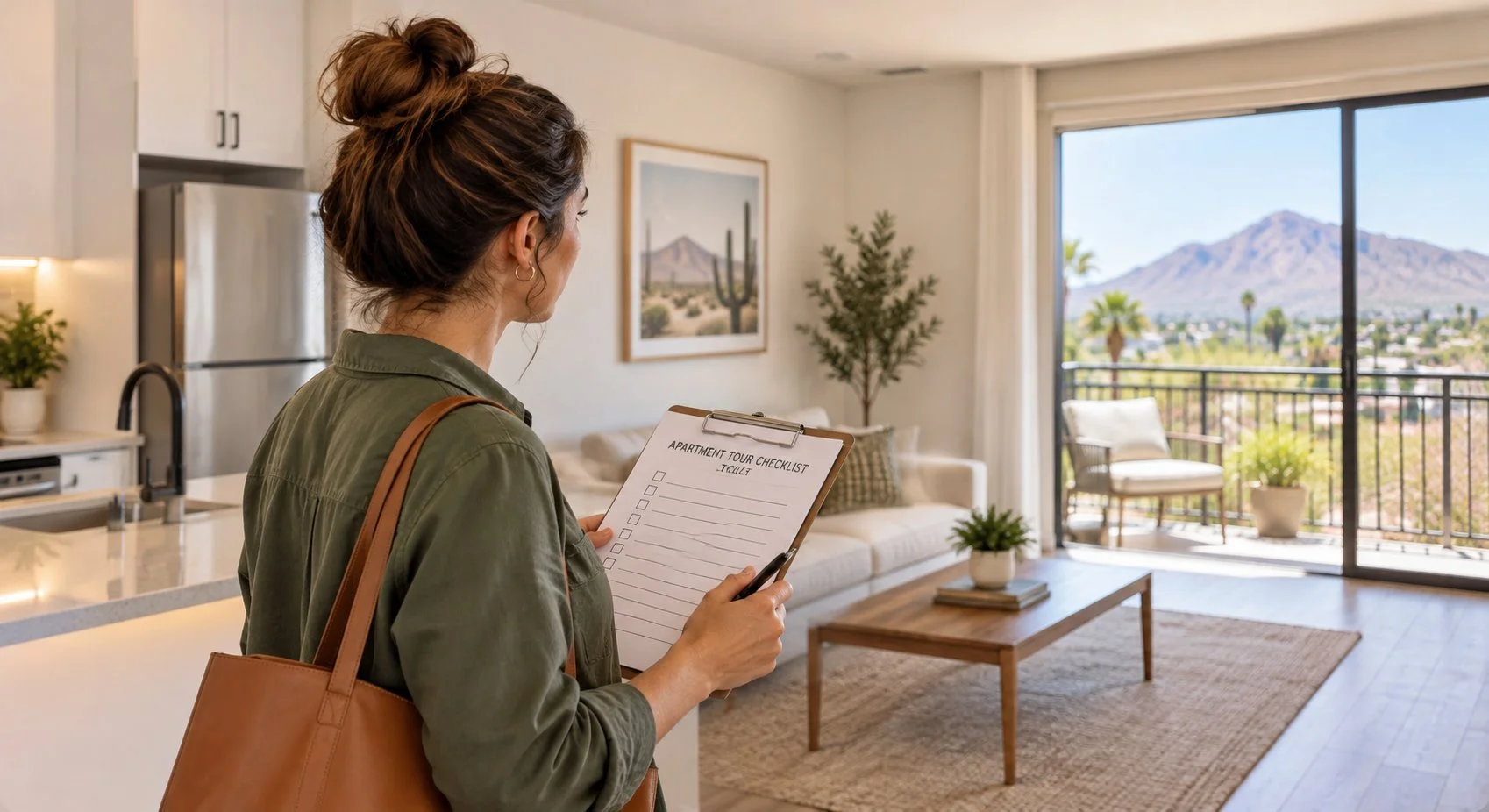
Apartment photos can tell you whether you like the countertops. A tour tells you whether you can actually live there.
That difference matters in Tucson, where an apartment's cooling system, afternoon sun exposure, parking setup, utility arrangement, and location can affect everyday comfort just as much as the floor plan. A unit that looks great online may feel completely different once you stand inside it at 4 p.m., open the closets, test the water pressure, and listen to what is happening outside.
A good apartment tour checklist keeps you from relying on memory or getting distracted by fresh paint and staging. It gives you a repeatable way to inspect each rental, ask the right questions, and compare your options after you leave.
The goal isn't to find a flawless apartment. It's to understand exactly what you're considering before you spend money on an application or commit to a lease.
Key Takeaways
Tour the actual unit you'll rent whenever possible, not only a model apartment.
Check cooling, windows, water, appliances, storage, noise, parking, and common areas rather than focusing only on finishes.
Ask for the full monthly cost, including recurring fees and utilities.
In Tucson, pay particular attention to AC performance, west-facing windows, shade, and the apartment's position within the building.
Take photos and notes so you can compare apartments accurately later.
Don't assume an issue will be repaired before move-in. Ask what will be completed and get important commitments in writing.
Treat the tour as both an inspection and a chance to understand how the property operates.
1. Before the Tour: Prepare Your Apartment Tour Checklist
A useful apartment tour starts before you arrive at the property.
If you're visiting three or four apartments over a weekend, details begin blending together surprisingly fast. You may remember that one had the bigger bedroom but forget which one charged separately for parking or which unit had the west-facing living room.
Before leaving home, create one checklist you can use for every property.
Confirm that you're seeing the actual apartment
Ask whether you'll be touring the exact unit available for rent.
Model apartments are useful for understanding a property's general style, but they may have a different orientation, floor, appliance package, condition, or view than the apartment you'll actually occupy.
If the actual unit isn't ready, ask:
Is the available unit the same floor plan?
Which floor is it on?
Which direction do its main windows face?
Are the appliances and finishes the same?
Does it have the same patio, storage, or parking arrangement?
When can you view the actual unit before signing?
This matters even when two apartments share the same layout. One may face a quiet courtyard while another faces a busy street. One may receive morning light while another gets direct afternoon sun.
Know your non-negotiables before you arrive
Write down the things that would make you reject an apartment regardless of how attractive it looks.
Your list might include:
Maximum total monthly housing cost
Required number of bedrooms
Pet acceptance
Ground-floor access
Covered parking
In-unit or on-site laundry
Reliable cooling
Specific move-in date
Proximity to work or school
Outdoor space
Storage needs
This prevents you from convincing yourself that a beautiful apartment will somehow make an important practical problem disappear.
If you're still narrowing your search, reviewing available rental properties in Tucson before scheduling tours can help you compare unit sizes, locations, included utilities, parking arrangements, and property-specific amenities.
Bring a few simple tools
You don't need professional inspection equipment.
A phone, notes app, measuring tape, charging cable, and your checklist are usually enough. The measuring tape is particularly useful if you already own large furniture or need to confirm that a desk, bed, dining table, or sofa will fit.
Take pictures where permitted, especially of details that will be difficult to remember later.
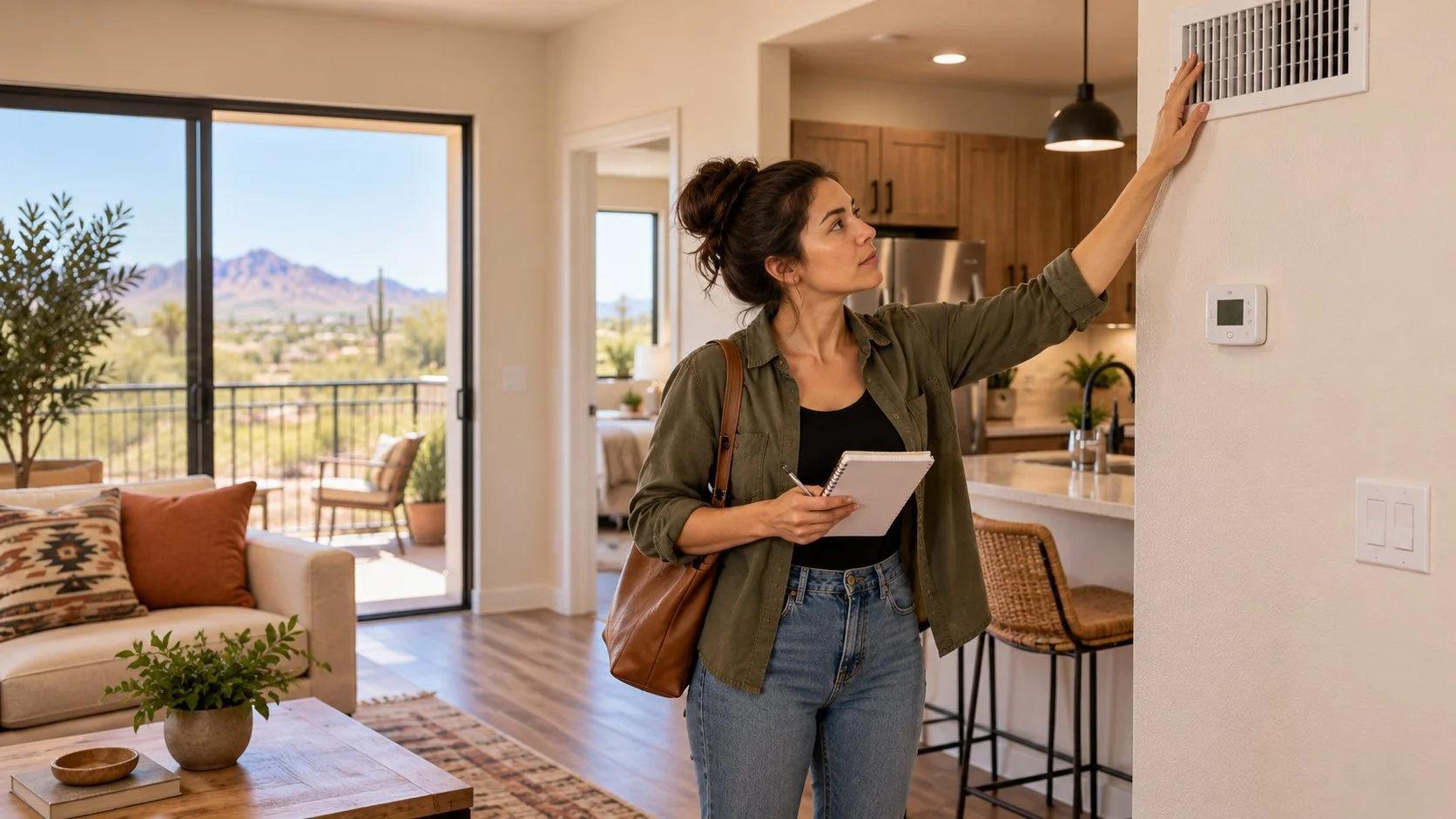
2. What to Look for When Touring an Apartment
Knowing what to look for when touring an apartment means going beyond whether the rooms feel spacious or the kitchen looks updated.
Walk through the property slowly enough to understand how it functions.
Start with the apartment's overall condition
Before focusing on individual features, look at the apartment as a whole.
Notice whether it appears clean and maintained. Fresh paint is easy to see, but also look at flooring edges, baseboards, doors, ceilings, cabinets, plumbing fixtures, and areas beneath sinks.
Watch for:
Water stains
Warped flooring
Cracks or damaged surfaces
Loose fixtures
Doors that don't close properly
Signs of leaks beneath sinks
Unusual odors
Pest activity
Damaged screens
Missing outlet covers
Visible gaps around windows or exterior doors
A minor cosmetic mark isn't necessarily a problem. What matters more is whether you see a pattern suggesting deferred maintenance.
Under Arizona Revised Statutes § 33-1324, landlords must maintain rental premises in a fit and habitable condition, including keeping supplied electrical, plumbing, heating, ventilation, and air-conditioning facilities in good and safe working order.
That doesn't mean you should attempt a legal or technical inspection during your tour. It does mean obvious maintenance concerns deserve questions before you apply.
Test the cooling system
In Tucson, this belongs near the top of the checklist.
According to the National Weather Service's Tucson climate normals, average daily high temperatures reach approximately 101.2°F in June, 100.2°F in July, and 98.6°F in August.
Don't settle for asking, "Does the apartment have AC?"
Ask what type of cooling system the unit uses, then notice whether airflow seems consistent between rooms.
Check:
Thermostat location
Supply vents
Ceiling fans
Temperature differences between rooms
Whether the system sounds unusually loud
Whether bedrooms appear to receive adequate airflow
You probably won't be able to judge an HVAC system completely during a short visit, especially if the apartment is vacant. The purpose is to identify questions and obvious concerns.
For more local context, understanding summer utility costs in Tucson apartments can help you see how cooling equipment, floor level, windows, shade, and sun exposure influence electricity expenses.
Check the windows, sunlight, and orientation
Natural light can make an apartment look fantastic during a tour. In Tucson, you also need to consider what that sunlight may mean later in the day.
Stand near the windows and check whether they close properly. Look at blinds or other window coverings. Notice where direct sunlight is entering the apartment.
West-facing windows deserve particular attention because they can receive intense afternoon sun when outdoor temperatures are already high.
Tucson Electric Power's summer energy-saving recommendations emphasize using shades, curtains, and other measures to reduce unwanted solar heat and help manage cooling expenses.
Ask which direction the apartment faces if it isn't obvious.
A morning tour may not reveal how warm a west-facing bedroom or living room becomes at 4 or 5 p.m.
Run the faucets and inspect the bathroom
If permitted, turn on faucets and showers.
You aren't conducting a plumbing inspection. You're simply checking the things you'll interact with every day.
Look for:
Reasonable water pressure
Hot water availability
Slow drains
Leaks around fixtures
Loose faucets
Toilet operation
Signs of previous water damage
Ventilation in the bathroom
Storage around the sink
Open the cabinet beneath the kitchen and bathroom sinks as well. This is one of the easiest places to notice moisture, staining, or obvious leaks.
Check every included appliance
Ask which appliances belong with the apartment and whether they'll be the same appliances present at move-in.
Open the refrigerator. Look inside the oven. Check the dishwasher if there is one. Ask whether the microwave, washer, dryer, garbage disposal, or other equipment is included.
You don't need to perform a full appliance test, but visible condition tells you more than a listing photo.
If something isn't working during the tour, ask directly:
"When will this be repaired or replaced?"
That produces a more useful answer than assuming it will be taken care of.
Look at storage like someone who already lives there
Empty apartments often feel larger than furnished ones.
Open closets and cabinets. Think about where you'll actually store clothing, cleaning supplies, luggage, bikes, groceries, linens, and everyday household items.
Measure key areas when necessary.
For example, a bedroom may technically fit your queen bed but leave almost no usable space once you add nightstands and a dresser.
Test your phone signal
Walk through the apartment while checking your mobile reception.
Signal strength can change between rooms or buildings. If you work from home or depend heavily on mobile service, poor reception may become annoying quickly.
Also ask what internet providers serve the property and whether internet is included, required through a specific provider, or bundled into a monthly package.
Listen before you leave
Spend at least a minute simply listening.
Stand in the bedroom with the door closed.
Can you hear:
Traffic?
Nearby businesses?
Dogs?
Courtyard activity?
HVAC equipment?
People in neighboring units?
Parking lot noise?
One quiet Tuesday morning doesn't tell you what Saturday night will sound like, but it gives you a baseline.
If noise is particularly important to you, consider returning to the surrounding area at a different time of day before committing.
Apartment Tour Checklist at a Glance
| Area | What to Check | What to Ask |
|---|---|---|
| Cooling | Airflow, vents, thermostat, fans | What cooling system does the unit use? |
| Windows | Seals, screens, sunlight, coverings | Which direction does the unit face? |
| Plumbing | Faucets, drains, toilet, leaks | How are maintenance requests handled? |
| Appliances | Visible condition and included items | Will these exact appliances remain? |
| Storage | Closets, cabinets, outdoor storage | Is any additional storage included? |
| Noise | Street, neighbors, equipment | Are there quiet-hour policies? |
| Parking | Location, lighting, availability | Is parking assigned or an extra charge? |
| Laundry | Location and condition | Is it in-unit, on-site, or off-site? |
| Safety | Locks, exterior lighting, access | How is building access controlled? |
| Costs | Rent and required add-ons | What is the total monthly amount? |

3. Questions to Ask on an Apartment Tour
The strongest questions to ask on an apartment tour are the ones that help you understand costs, maintenance, daily rules, and what happens after you move in.
Don't worry about asking too many questions. You're considering where you'll live and what may be one of your largest monthly expenses.
What will I actually pay every month?
Ask for the full recurring cost.
That could include:
Base rent
Water
Sewer
Trash
Electricity
Gas
Internet
Parking
Pet rent
Required service packages
Pest-control fees
Other recurring property charges
Don't compare apartments using rent alone when the included services are different.
For example, consider two Tucson apartments:
Apartment A rents for $1,100 but charges separately for water, trash, parking, and internet. Apartment B rents for $1,175 and includes several of those items. You cannot tell which costs less simply by comparing $1,100 with $1,175.
When evaluating rental fees, deposits, and potential deal red flags in Tucson, it's important to separate advertised rent from recurring charges and the upfront expenses required to move in.
How much will I need to pay before moving in?
Monthly costs are only half the equation.
Ask about:
Application fees
Security deposit
Administrative fees
Holding deposits or holding fees
Pet deposits or fees
Prorated first-month rent
Other required move-in charges
Ask which charges are refundable and which are not.
Getting this information before submitting an application helps prevent a situation where you pass screening but discover that the move-in amount exceeds your budget.
How does maintenance work?
A well-run maintenance process can matter more over a 12-month lease than an upgraded backsplash.
Ask:
How do residents submit routine maintenance requests?
Is there an online portal?
What counts as an emergency?
Is emergency maintenance available after hours?
Who should residents contact if AC stops working?
What maintenance tasks are the resident's responsibility?
Arizona tenants are required to promptly notify landlords in writing about situations requiring maintenance or repair, as outlined in Arizona Revised Statutes § 33-1341. This makes understanding the property's maintenance reporting process useful from the beginning.
What are the rules for parking?
Never assume that seeing an open space during your tour means you'll have one after moving in.
Ask whether parking is:
Assigned
Covered
First come, first served
Included
Paid separately
Permit-controlled
If you have two vehicles, ask whether both can be accommodated.
Also ask where guests park. A property can have adequate resident parking but very limited visitor options.
What is the pet policy?
If you have a pet or might get one during the lease, clarify the rules before applying.
Ask about:
Allowed animals
Size or other restrictions
Pet deposits
Nonrefundable fees
Monthly pet rent
Maximum number of pets
Outdoor areas
Don't rely solely on a listing's "pet friendly" label. The property-specific rules are what matter.
What is the laundry setup?
If laundry isn't inside the apartment, walk to the laundry area during your tour.
Notice:
Distance from the unit
Number of machines
Payment method
Hours
Lighting
General condition
"On-site laundry" can mean a convenient room ten steps away or a longer walk across a large property.
Are there plans for renovations or construction?
A quiet apartment can feel very different when roof work, exterior renovations, or construction begins nearby.
Ask whether any major work is currently planned for the building or property.
This is especially worth asking if you notice construction materials, vacant units undergoing renovation, or active work during your visit.
What happens after I apply?
Before spending money on screening, understand the process.
Ask what documentation is required, whether all adults must apply, how applicants are screened, how availability is handled during the application process, and when a unit is considered reserved.
If you're unfamiliar with the steps involved, reviewing the Tucson rental application process can help you prepare the necessary documents and understand what to expect before paying an application fee.
4. Tucson Apartment Viewing Tips That Deserve Extra Attention
Most apartment-tour advice applies anywhere. Tucson adds a few local considerations that are easy to underestimate if you're relocating from a cooler climate.
Tour later in the day when possible
If you're seriously considering a unit, an afternoon visit can reveal things a morning tour won't.
You may get a better sense of:
Afternoon sun exposure
Indoor temperature differences
Parking availability
Traffic
Neighborhood activity
Noise
This doesn't mean you need two formal tours of every apartment. Reserve the extra visit for your strongest candidates.
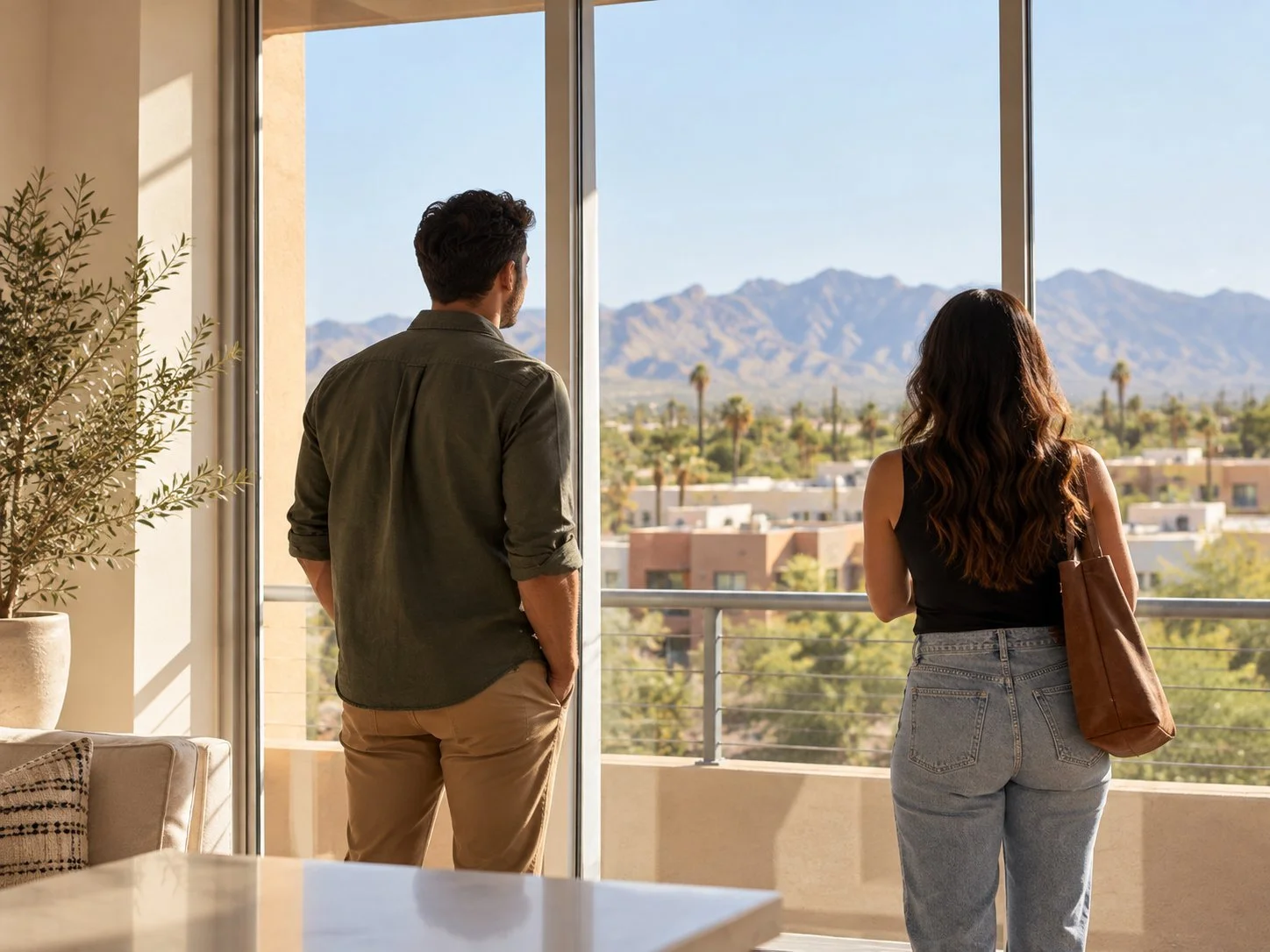
Pay attention to the unit's position in the building
The same floor plan can live differently depending on where it sits.
Ask whether the unit is:
Top floor
Ground floor
Corner unit
Interior unit
Adjacent to stairs
Near the laundry room
Near the pool
Facing parking
Facing the street
Facing an interior courtyard
A top-floor apartment may offer more privacy from upstairs neighbors. A ground-floor apartment may make groceries and moving easier. A courtyard-facing apartment may reduce traffic exposure but place you closer to communal activity.
There isn't one "best" position. The point is to understand the tradeoff.
Look for shade
Trees, covered patios, neighboring buildings, roof overhangs, and window coverings can all change how much direct sunlight reaches an apartment.
Shade may be particularly valuable around west-facing rooms.
Look at the property itself too. Covered parking can make a noticeable difference when your vehicle has been sitting outside during a Tucson summer afternoon.
Ask exactly what "utilities included" means
This phrase is too vague to use for comparison without details.
One property may include water and trash. Another may include Wi-Fi and parking. Electricity may remain the resident's responsibility.
Current Tucson rental listings can have different utility arrangements, even when their advertised rents appear similar.
Write down the exact arrangement for each property rather than relying on memory.
Walk the immediate neighborhood
The tour doesn't end when you walk out of the apartment.
Spend five or ten minutes around the surrounding block.
Look for practical things:
Grocery access
Public transportation
Bike routes
Sidewalks
Street lighting
Nearby restaurants
Major roads
Schools
Medical facilities
Everyday errands
If you're relocating, map your likely commute during the time of day you'd actually travel.
A property can look "close" to Downtown Tucson, the University of Arizona, or your workplace on a map while still producing a commute you don't enjoy.
5. How to Compare Apartments After Your Tours
The best time to evaluate an apartment isn't while you're standing beside the leasing agent. It's after you've left and can compare it with the other options objectively.
Use the same categories for every apartment.
Score what actually matters to you
A simple five-point system works well.
| Category | Apartment A | Apartment B | Apartment C |
|---|---|---|---|
| Total monthly cost | /5 | /5 | /5 |
| Cooling and sun exposure | /5 | /5 | /5 |
| Location and commute | /5 | /5 | /5 |
| Layout | /5 | /5 | /5 |
| Storage | /5 | /5 | /5 |
| Parking | /5 | /5 | /5 |
| Laundry | /5 | /5 | /5 |
| Noise | /5 | /5 | /5 |
| Property condition | /5 | /5 | /5 |
| Overall fit | /5 | /5 | /5 |
Don't give every category equal importance automatically.
If you work from home, quiet and reliable cooling might matter more than being close to nightlife. If you commute daily, location and parking may outrank square footage.
Separate fixable problems from permanent ones
This distinction can simplify your decision.
A missing showerhead can be replaced. A scratched cabinet can be repaired. A wall can be repainted.
You can't easily change:
The building's location
The bedroom size
The apartment's orientation
Traffic outside
The floor it's on
The distance to parking
The basic layout
Give permanent characteristics more weight.
Get promises in writing
If you're told that something important will be repaired, replaced, cleaned, painted, or installed before move-in, ask whether that commitment can be documented.
Examples include:
Damaged blinds being replaced
A broken appliance being repaired
Carpet being cleaned
A door lock being fixed
Missing screens being installed
Verbal conversations are easy to remember differently later.
Don't let a rushed tour create a rushed decision
A property may have legitimate reasons for needing an answer quickly, especially when rental demand is active.
You still need enough information to understand what you're applying for.
Before paying an application fee, you should be able to answer four basic questions:
Can I comfortably afford the total cost?
Does the apartment meet my non-negotiable needs?
Did I notice any unresolved condition or maintenance concern?
Do I understand the application and lease process well enough to move forward?
If the answer to one of those is "I don't know," identify what information is missing first.
A Better Apartment Tour Leads to a Better Rental Decision
The purpose of an apartment tour isn't to prove that a unit is perfect. It's to find out whether the reality matches the listing and whether the tradeoffs work for you.
Bring an apartment tour checklist, test the everyday basics, ask about the full cost, inspect the cooling setup, look beyond staging, and write down what you learn.
In Tucson, give extra attention to heat exposure, AC, shade, utilities, parking, and the unit's position within the property. Those practical details may matter long after the excitement of finding a new apartment wears off.
A thoughtful 30-minute tour can save you from spending an entire lease wishing you'd asked one more question.
FAQs
How long should an apartment tour take?
Plan on roughly 20 to 30 minutes for a straightforward apartment, with additional time if you're reviewing amenities or asking detailed questions. Rushing through in five minutes makes it much easier to miss issues involving storage, appliances, noise, windows, or maintenance.
What should I bring to an apartment tour?
Bring your phone, an apartment tour checklist, notes, a measuring tape, and measurements for any large furniture you already own. If you may apply immediately afterward, you can also ask in advance which identification or application documents you'll need.
Should I take pictures during an apartment tour?
Yes, as long as the property representative allows it. Photos are useful when you're comparing several similar apartments and trying to remember differences in layouts, appliance condition, storage, windows, or views.
What should I ask about AC when touring an apartment in Tucson?
Ask what type of cooling system the unit uses, how maintenance requests are handled, and whether the same system serves all rooms effectively. Also consider the floor level, window orientation, shade, and direct afternoon sunlight because cooling performance is only one part of summer comfort.
Should I tour an apartment twice before applying?
Not every rental needs a second visit, but it can be useful for your top choice. Seeing the area at another time of day may reveal different traffic, parking, sunlight, neighborhood activity, or noise conditions.
What are the biggest red flags during an apartment tour?
Repeated signs of poor maintenance deserve attention, especially active leaks, significant water damage, broken locks, malfunctioning appliances, persistent unusual odors, or evasive answers about repairs and costs. One cosmetic flaw doesn't necessarily mean a property is poorly managed; patterns are more informative.
What should I check before leaving an apartment tour?
Before you walk out, make sure you understand the total monthly cost, move-in charges, utility arrangement, parking, pet rules if applicable, maintenance process, application requirements, and expected move-in date. Then photograph or write down the important details while they're still fresh.