
Beating the Heat: Understanding Utility Costs in a Tucson Apartment
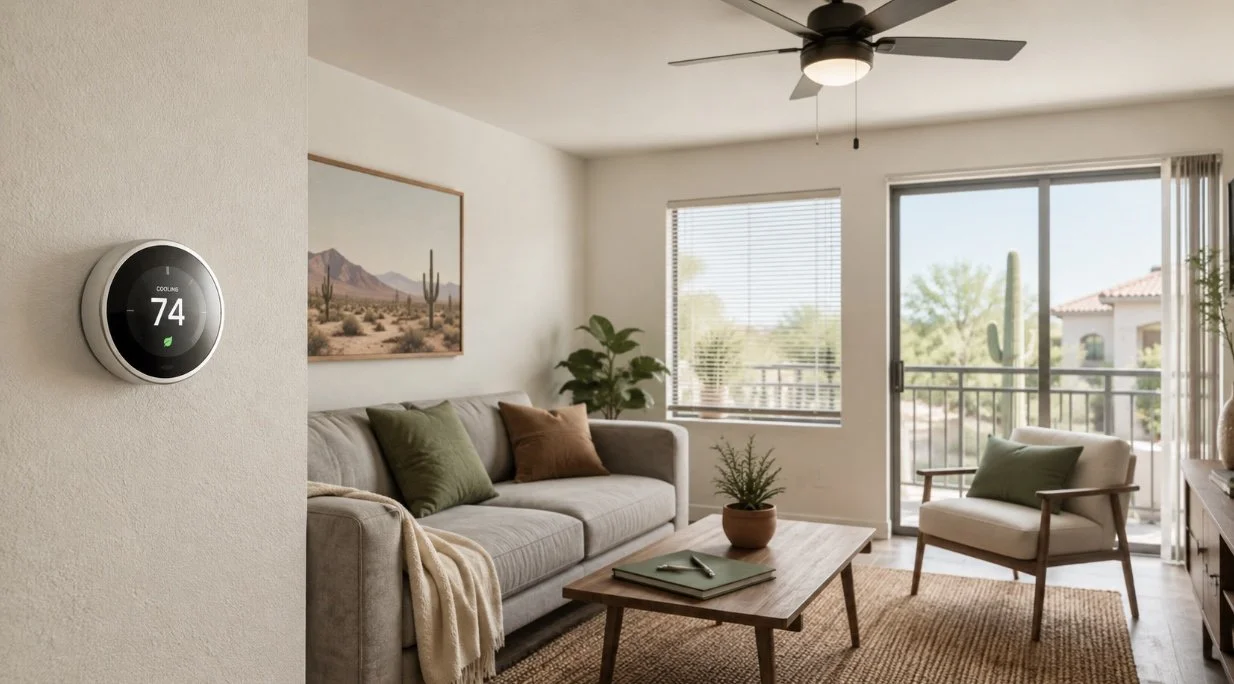
Rent is only part of what it costs to live comfortably in Tucson. For renters comparing apartments in Tucson AZ, electricity deserves particular attention because air conditioning can become one of the largest variable household expenses during the hottest months.
Two apartments with similar rent can produce very different monthly costs. Floor level, afternoon sun, windows, air-conditioning equipment, utility inclusions, and even the direction the unit faces can all matter. Understanding those details before you sign a lease gives you a much clearer picture of what the apartment will actually cost to live in.
Key Takeaways
Tucson's summer climate can make cooling a major part of an apartment's electricity use.
There is no single reliable "average electric bill Tucson apartment" figure that applies to every renter.
Apartment size matters, but sun exposure, floor level, insulation, windows, and cooling equipment can matter just as much.
Ask exactly which utilities are included before comparing rents between properties.
A slightly higher rent can sometimes make financial sense if the apartment includes utilities or has features that reduce cooling demand.
Your habits still matter, especially thermostat settings, window coverings, fan use, and when you run large appliances.
Why Tucson apartment utility costs change so much
Tucson's climate makes electricity use unusually seasonal. National Weather Service climate normals put Tucson's normal June high at about 101°F, with normal highs around 100°F in July and nearly 99°F in August. That means an apartment that feels inexpensive to operate in January may tell you very little about what it will cost during June, July, or August.
Tucson Electric Power (TEP) reported that its residential customers paid about $140 per month on average during 2025. That figure is useful as broad local context, but it should not be treated as the average electric bill for a Tucson apartment. It includes different types and sizes of homes, household sizes, cooling systems, rate plans, and energy-use patterns.
Why an "average electric bill Tucson apartment" can be misleading
Imagine two renters who each occupy a 700-square-foot one-bedroom apartment.
The first lives in a ground-floor unit shaded by another building. The windows receive limited afternoon sun, the cooling equipment is relatively efficient, and the renter uses ceiling fans.
The second lives on the top floor of an exposed building with west-facing windows. Direct afternoon sunlight heats the apartment for hours, and the air conditioner must work harder to keep the same indoor temperature.
Their apartments have virtually identical square footage. Their summer electricity use may still be very different.
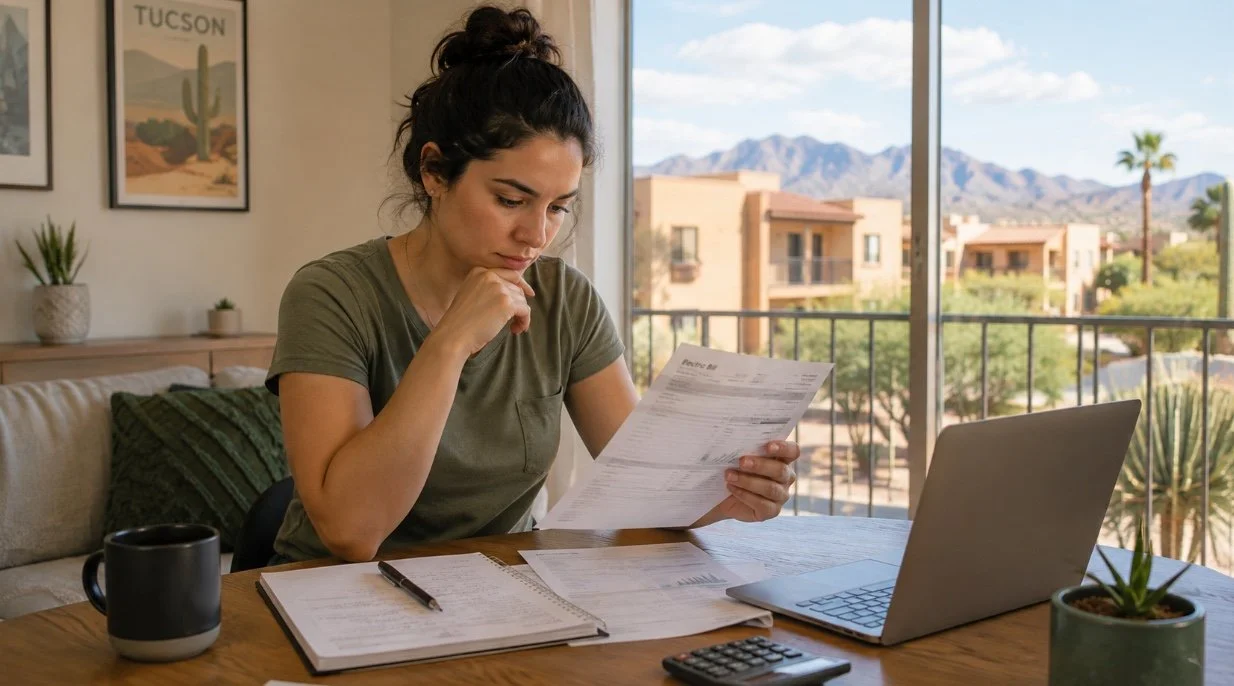
Why an "average electric bill Tucson apartment" can be misleading
Imagine two renters who each occupy a 700-square-foot one-bedroom apartment.
The first lives in a ground-floor unit shaded by another building. The windows receive limited afternoon sun, the cooling equipment is relatively efficient, and the renter uses ceiling fans.
The second lives on the top floor of an exposed building with west-facing windows. Direct afternoon sunlight heats the apartment for hours, and the air conditioner must work harder to keep the same indoor temperature.
Their apartments have virtually identical square footage. Their summer electricity use may still be very different.
Understand what the electric bill actually includes
Electric bills are not calculated from apartment size alone. Your electricity consumption is measured in kilowatt-hours, or kWh, and the rate you pay depends partly on your pricing plan.
TEP currently offers multiple residential pricing structures, including Basic and Time-of-Use options. Under Time-of-Use pricing, electricity charges vary depending on when energy is consumed, so two households using a similar amount of power can face different costs based on their usage patterns.
If you're moving into your first Tucson rental, it is worth reading the utility section closely when reviewing questions to ask before signing an Arizona apartment lease. Find out what you pay directly, what is billed through management, and what is already covered by the rent.
What to look for in apartments in Tucson AZ
When touring apartments in Tucson AZ, most renters naturally notice the kitchen, flooring, storage, parking, and neighborhood first. During the hotter part of the year, the less glamorous details can have a greater effect on comfort.
Instead of asking only, "Does it have air conditioning?" look at how the entire apartment handles heat.
Start with the cooling system
Ask what type of cooling system the apartment uses and who is responsible for maintaining it.
During a tour, notice whether every room seems to receive adequate airflow. If one bedroom feels much warmer than the living area, ask why. Look at supply vents, thermostat placement, ceiling fans, and whether filters appear accessible.
If you notice a cooling problem after moving in, report it rather than assuming an unusually hot apartment is simply part of living in Arizona. A maintenance issue and normal summer heat are not the same thing.
TEP recommends regular air-conditioning maintenance and notes that filters should be kept clean because proper maintenance helps equipment operate effectively. Renters should confirm which maintenance tasks belong to them and which belong to the property owner or manager.
Look at windows, orientation, and shade
A beautifully bright apartment can also receive a large amount of solar heat.
West-facing glass deserves extra attention because Tucson's strongest afternoon sun can reach windows when outdoor temperatures are already high. TEP specifically recommends shades or curtains, particularly for west-facing rooms, to block afternoon heat.
During your tour, check:
Whether windows close completely and appear to seal properly.
Whether bedrooms receive direct afternoon sun.
Whether blinds or other coverings are already installed.
Whether patios, trees, roof overhangs, or neighboring buildings provide shade.
Whether the main living space has a ceiling fan.
Whether exterior doors have obvious gaps around them.
Touring at 9 a.m. can make almost any apartment feel comfortable. Seeing the same unit late in the afternoon often tells you more about its summer conditions.
Consider the apartment's position in the building
Top-floor units can offer privacy and fewer upstairs neighbors, but their exposure differs from a first-floor apartment. Corner units may have additional exterior walls. Units surrounded by other conditioned apartments may experience different heat gain than units with several exterior surfaces.
This does not mean one position is always better. It simply belongs in the decision alongside rent, noise, privacy, stairs, and natural light.
If central location is also important, browsing Midtown Tucson apartments can help you compare different floor plans and building styles without treating every Tucson rental as interchangeable.
How to control summer cooling costs in Tucson
You do not need to spend the summer sitting in an uncomfortable apartment to save electricity. The better approach is to reduce unnecessary heat gain and help the cooling system do its job.
Set the thermostat deliberately
The U.S. Department of Energy recommends setting your thermostat as high as comfortably possible during warm weather because a smaller difference between indoor and outdoor temperatures reduces the cooling load. TEP also recommends 78°F as a useful summer reference point while emphasizing that comfort varies by household.
That does not mean every renter must keep an apartment at exactly 78°F. Health needs, pets, sleep preferences, apartment orientation, and humidity can affect what feels reasonable.
The useful principle is consistency. Setting the thermostat dramatically colder because the apartment feels hot does not make an air conditioner cool the space instantly. Instead, use a comfortable setting, reduce incoming heat, and report equipment that cannot maintain reasonable conditions.
Use fans for people, not empty rooms
Moving air can make you feel cooler without requiring the thermostat to be set as low. TEP recommends ceiling and oscillating fans for this reason.
A fan cools people through air movement rather than lowering the room's actual temperature, so turn it off when everyone leaves the room. Running several fans around an empty apartment simply adds electricity use without improving anyone's comfort.
Block afternoon heat before it enters
Waiting until a room is already hot makes the air conditioner deal with heat that could have been prevented.
Close blinds or curtains on windows receiving direct sunlight, especially during the afternoon. If your lease permits renter-friendly blackout curtains or thermal window treatments, they may be useful for strongly exposed rooms.
At night, outdoor temperatures may fall enough to reduce the cooling load, but Tucson evenings can remain very warm during peak summer. Do not assume opening every window is automatically more efficient. Compare outdoor and indoor conditions first.
Shift flexible electricity use when your plan rewards it
TEP's Time-of-Use plans charge different energy rates during different periods. Its current Time-of-Use schedule applies higher summer rates during designated on-peak hours and lower rates during off-peak periods.
For renters on an applicable plan, this can make the timing of flexible tasks relevant. Laundry, dishwashing, or charging certain devices may be cheaper outside peak periods.
Before rearranging your routine, confirm which pricing plan you actually have. Advice about avoiding peak hours is much less relevant if you are on a plan that does not price electricity that way.
Watch the first full summer bill carefully
Your first complete billing cycle during hot weather is far more useful than guessing based on someone else's apartment.
Compare:
Total kWh used.
Billing-cycle length.
Thermostat habits.
Whether guests were staying with you.
Any unusually hot periods.
Changes in laundry, cooking, or work-from-home patterns.
The number on the bill tells you what you owe. The usage history helps explain why.
If usage suddenly jumps without a clear lifestyle change, check for simple causes first. A dirty filter, thermostat setting change, window left partially open, or cooling equipment problem may be involved.
How to compare utilities-included and energy-efficient apartments
The cheapest advertised rent is not necessarily the cheapest apartment to occupy.
When comparing two rentals, calculate your expected housing cost using the same categories for both:
monthly rent + required fees + electricity + water/sewer + internet + other recurring charges
This is especially helpful when evaluating utilities-included apartments in Tucson.
What does "utilities included" actually mean?
The phrase can describe very different arrangements.
One property might include water and sewer. Another might include internet and parking. A third might include several utilities while electricity remains the tenant's responsibility.
For example, Goldengate on Richey currently lists water and sewer as included, while Old Town Apartments lists parking and high-speed internet among its included features. These examples show why renters should read the individual property details rather than treating "included utilities" as a standard package.
Ask for the exact list before comparing monthly costs.
A simple rental comparison example
Suppose Apartment A costs $1,075 per month and Apartment B costs $1,125.
At first glance, Apartment A saves $50.
But Apartment B includes internet and water, while Apartment A does not. Apartment B also has better-shaded windows and an efficient cooling setup, although electricity remains the renter's responsibility.
That does not automatically make Apartment B cheaper. It means the correct comparison is not $1,075 versus $1,125. You need to estimate the complete recurring cost of each unit.
This is particularly useful when viewing current Tucson rental availability. Compare what comes with each individual apartment rather than assuming two units with similar rent have similar monthly expenses.
What makes an apartment energy-efficient?
Energy-efficient apartments in Tucson do not have one universal feature list. Efficiency comes from how several parts of the property work together.
Useful characteristics can include well-maintained cooling equipment, effective window coverings, tight-fitting windows and exterior doors, efficient lighting, and a layout that can be cooled without wasting energy on unused space.
The U.S. Department of Energy explains that air-conditioner efficiency is commonly measured through ratings such as the Seasonal Energy Efficiency Ratio (SEER), with higher ratings indicating greater cooling efficiency. As a renter, however, you usually do not need to become an HVAC expert. Asking the age and type of the cooling system and looking at the apartment's overall heat exposure is more practical.
A practical utility checklist before signing a lease
A 10-minute utility check during the apartment-shopping process can prevent unpleasant surprises later.
Use this process before committing to a Tucson rental.
1. Identify every utility you will pay
Ask which services are:
Included in rent.
Billed directly by a utility company.
Billed separately through property management.
Shared or allocated between units.
Do not rely on a listing headline if the lease provides more specific information.
2. Ask about the cooling equipment
Find out whether the unit uses central air conditioning or another cooling system.
Ask who handles maintenance, filter changes, and repair requests. If you're viewing an occupied or recently vacated apartment, ask whether there have been recent HVAC repairs or upgrades.
3. Inspect the apartment during daylight
Check which rooms receive direct sun.
Look at the windows, blinds, exterior doors, and shading. Stand near closed windows and doors and notice obvious drafts or gaps.
4. Compare total recurring costs
Write down rent and every predictable recurring housing expense.
Do this for each apartment you're seriously considering. Memory becomes unreliable after several tours, particularly when properties include different combinations of parking, internet, water, or other services.
5. Ask for historical utility context when available
A property manager may not be able to predict your bill because individual usage varies. Still, it is reasonable to ask whether any information about the unit's typical utility setup is available.
Treat previous bills as context rather than a promise. A prior tenant might have kept the thermostat at 82°F and traveled frequently, while you work from home and prefer a cooler apartment.
6. Match the unit to your real routine
Someone who leaves for work every weekday has a different energy pattern from someone working remotely.
Likewise, roommates, pets, frequent cooking, gaming computers, laundry habits, and preferred sleeping temperatures all influence electricity consumption.
An efficient apartment cannot compensate completely for high energy use, and careful habits cannot completely compensate for a poorly performing cooling system.
7. Read the lease before paying based on assumptions
Utility responsibilities should be clear in the rental agreement.
If something discussed during the tour matters to your budget, confirm that the written lease reflects the arrangement. This applies to included utilities, recurring fees, maintenance responsibilities, and services bundled with the apartment.
For renters prioritizing a walkable location near the University of Arizona, 4th Avenue, and the Sun Link streetcar, West University Tucson apartments provide another useful comparison point when weighing neighborhood convenience alongside housing costs.
Make Tucson apartment costs easier to predict
The best way to budget for desert apartment living is to stop treating utilities as an afterthought. Look beyond rent and consider the apartment's cooling system, sun exposure, floor position, included services, and your own daily habits.
A Tucson summer will test how an apartment handles heat. Asking the right questions before signing a lease gives you a much better chance of choosing a home that remains comfortable without turning every summer electric bill into a surprise.
FAQs
How much is the average electric bill for a Tucson apartment?
There is no reliable single average that applies specifically to every Tucson apartment. TEP reported an average residential bill of roughly $140 per month for its customers in 2025, but that includes many types of homes and usage patterns, so renters should not use it as an apartment-specific estimate.
Why is my Tucson electric bill much higher in summer?
Air conditioners generally run longer as outdoor temperatures rise, increasing electricity consumption. Tucson's normal daytime highs are around or above 100°F during much of June and July, so the seasonal difference can be substantial.
What thermostat temperature should I use in a Tucson apartment?
TEP and the U.S. Department of Energy use 78°F as a useful summer reference, while recommending that households keep thermostats at the highest temperature they find comfortable. Your appropriate setting may differ because of health needs, pets, sun exposure, and personal comfort.
Are utilities usually included in Tucson apartment rent?
It depends on the property. Some rentals include services such as water, sewer, internet, or parking, while tenants remain responsible for electricity, so confirm every included service before comparing rents.
Are top-floor apartments more expensive to cool in Tucson?
They can require more cooling because the roof receives substantial solar exposure, but building design, insulation, shading, windows, and HVAC performance all affect the result. Do not reject a top-floor unit automatically; evaluate the individual apartment.
How can I tell if a Tucson apartment is energy-efficient before renting it?
Look at the cooling system, window condition, direct afternoon sun, available shade, ceiling fans, window coverings, and obvious gaps around doors or windows. Ask about equipment maintenance and tour the apartment during the warmer part of the day when possible.
Does time of day affect electricity costs in Tucson?
It can if you are enrolled in a Time-of-Use or demand-based TEP pricing plan. Those plans charge differently depending on when electricity is used, so check your actual plan before changing your routine.
