

A lease may be several pages long, but many of your rights as an Arizona renter do not depend on memorizing every clause. State law sets rules for security deposits, repairs, landlord access, essential services, notices, and eviction procedures.
For Tucson tenants, there is another practical concern: reliable cooling during Arizona's hottest months. Understanding renters rights Arizona law provides before a problem occurs can make it much easier to document an issue, communicate with a landlord, and know when to seek qualified legal help.
This article provides general educational information, not legal advice. Rental laws can change, and the correct remedy depends on the facts of a specific tenancy. If you are facing eviction, unsafe housing conditions, loss of essential services, or a significant financial dispute, consider speaking with an Arizona attorney or qualified tenant assistance organization.
Key Takeaways
Most standard residential rentals in Tucson are governed by the Arizona Residential Landlord and Tenant Act.
Arizona generally limits security a landlord can demand to one and one-half months' rent, subject to specific rules and exceptions.
Landlords have duties related to habitable conditions, repairs, common areas, plumbing, electrical systems, and certain essential services.
Landlord entry normally requires at least two days' notice, with exceptions such as emergencies and certain maintenance requests.
A repair problem does not automatically allow a tenant to stop paying rent or deduct repair costs.
Eviction requires legal notice and a court process. A landlord cannot simply change the locks to bypass that process.
Tucson has local cooling standards in addition to broader Arizona rental laws.
How Arizona rental law applies to Tucson tenants
The main state law covering conventional apartments and rental houses is the Arizona Residential Landlord and Tenant Act, commonly shortened to ARLTA. It establishes duties for landlords and tenants involving rental agreements, deposits, access, maintenance, tenant conduct, notices, and legal remedies.
Renters who want to check the law directly can use the Arizona Department of Housing's official Arizona Residential Landlord and Tenant Act resource.
Not every living arrangement is treated identically. Hotels, some institutional housing, mobile home parks, public housing programs, and other specialized arrangements may be governed by different statutes or additional rules. A University of Arizona student renting a conventional private apartment, for example, may have different legal protections from someone living in university-operated housing.

The lease and the law work together
Your lease remains important. It establishes practical details such as the monthly rent, due date, lease term, utility responsibilities, pet rules, parking arrangements, renewal provisions, and property requirements.
The lease does not automatically override duties imposed by Arizona law. At the same time, renters should not assume that every disagreement with management amounts to a statutory violation. An inconvenience, maintenance delay, or disagreement over a property rule can be frustrating without necessarily creating a specific legal remedy.
Before signing, read the complete rental agreement rather than relying only on an online listing or conversation during a tour. If you are still comparing properties, checking current Tucson rental availability alongside the written lease terms can help you compare rent, utilities, property features, and other costs before applying.
Tenant responsibilities matter too
Tenant rights also come with responsibilities. Arizona law generally expects tenants to keep their part of the premises reasonably clean and safe, dispose of waste properly, use plumbing and electrical facilities reasonably, avoid deliberately or negligently damaging the property, and avoid interfering with neighbors' peaceful enjoyment.
Tenants should also report maintenance problems promptly. Written maintenance requests are especially useful because they establish when the landlord was notified, what condition was reported, and how the issue was described.
That record becomes more important when a problem continues for several days or involves an essential service.
Renters rights Arizona tenants should know before signing
Many rental disputes are easier to understand when they are separated into specific issues. A disagreement about a deposit is different from an air-conditioning failure, and both are different from a disagreement over landlord entry.
The following areas are among the most useful for Tucson renters to understand before moving into an apartment or rental house.
Security deposits and move-in documentation
Arizona law generally limits the security and prepaid rent a landlord can require to one and one-half months' rent. A tenant may voluntarily pay additional rent in advance, but that is different from a landlord requiring additional security.
Arizona law also addresses how nonrefundable fees must be identified and what happens to a refundable security deposit after the tenancy ends. Renters can review the specific requirements in Arizona's official security deposit statute.
The move-in process matters just as much as the amount you pay.
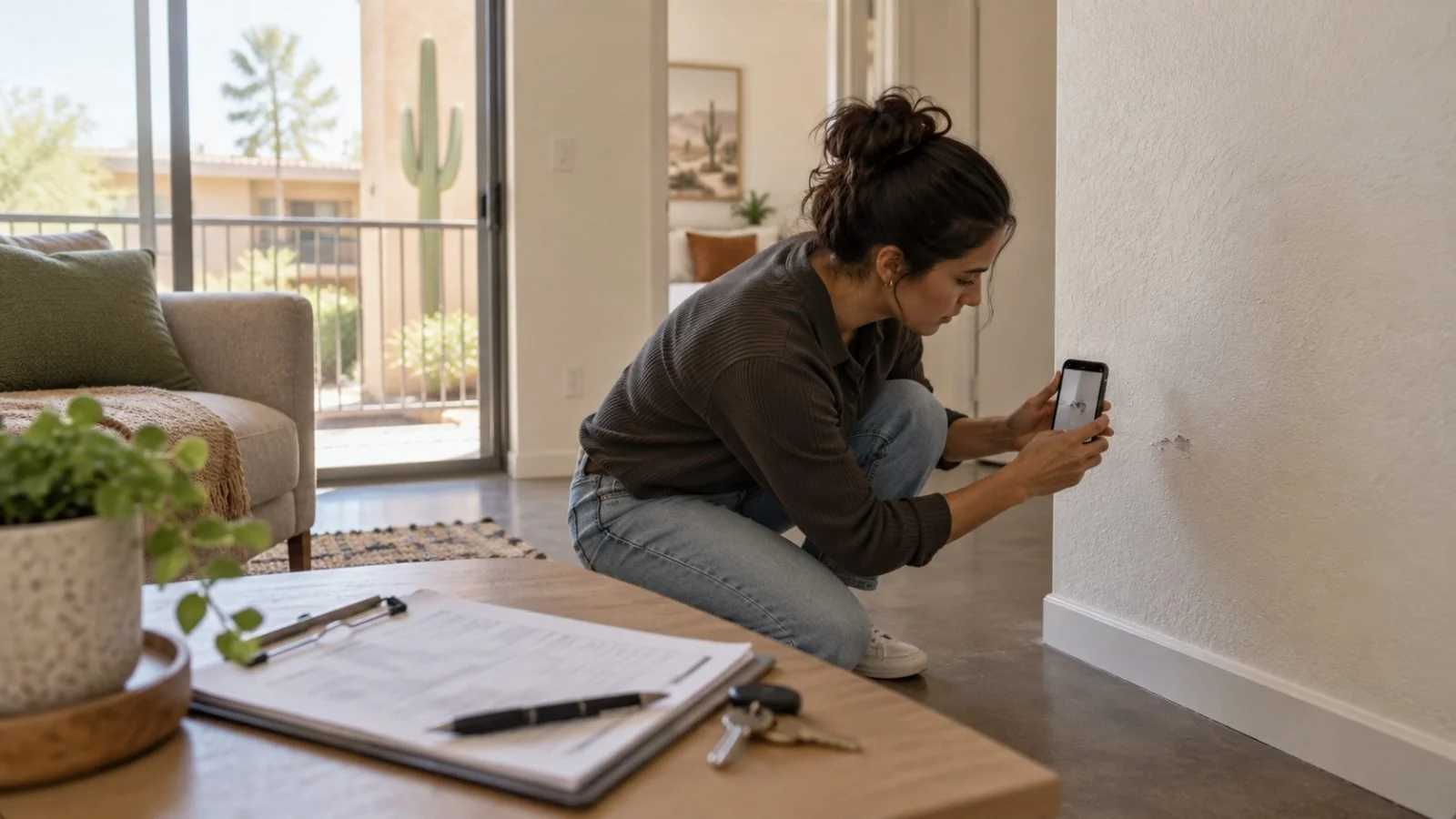
Inspect the apartment before you settle in. Photograph stains, damaged blinds, cracked tile, appliance problems, chipped countertops, wall damage, or anything else that was already present. Save the photos with their original dates and complete the property's move-in condition form accurately.
This is not just paperwork. If management later attributes existing damage to your tenancy, dated photos and a completed move-in report give both sides a clearer record of the unit's original condition.
At move-out, keep copies of your notice, forwarding address, inspection records, keys-return documentation, and any communication about the deposit.
Privacy and landlord entry
Renting an apartment does not mean management can enter whenever it wants.
Arizona law generally requires landlords to provide at least two days' notice before entering a rental unit and to enter at reasonable times. Exceptions can apply, including emergencies and circumstances connected with maintenance requests.
The details appear in Arizona's landlord access statute.
One distinction is particularly useful to understand. When you request maintenance or another service, that request can affect the landlord's permission to enter for the purpose of completing the requested work.
For example, submitting a request about a leaking kitchen faucet is different from management deciding to conduct an unrelated inspection. Reading notices carefully and keeping maintenance requests in writing reduces confusion about why access is being requested.
Habitability and basic maintenance
Arizona landlords have statutory responsibilities involving the condition of residential rental property. These duties can include necessary repairs, safe common areas, plumbing and electrical systems, and landlord-supplied heating, cooling, ventilation, and other facilities.
That does not mean every cosmetic issue makes an apartment legally uninhabitable.
A cabinet with worn paint is different from exposed wiring. A loose closet handle is different from a plumbing failure that leaves a home without usable water. The seriousness of the condition, its effect on health or safety, and the landlord's legal responsibilities all matter.
Renters should report problems accurately rather than overstating them. A maintenance request that says, "The bedroom outlet sparks when a plug is inserted" gives management more useful information than a vague message saying, "Electrical system is bad."
Tucson cooling rules deserve special attention
Cooling deserves particular attention in Tucson because an equipment failure can have a much greater impact in summer than it would in a milder climate.
Tucson has local housing provisions concerning cooling in habitable rooms, in addition to state-level landlord duties. Renters who have an unresolved cooling problem can check the applicable requirements in the City of Tucson housing code.
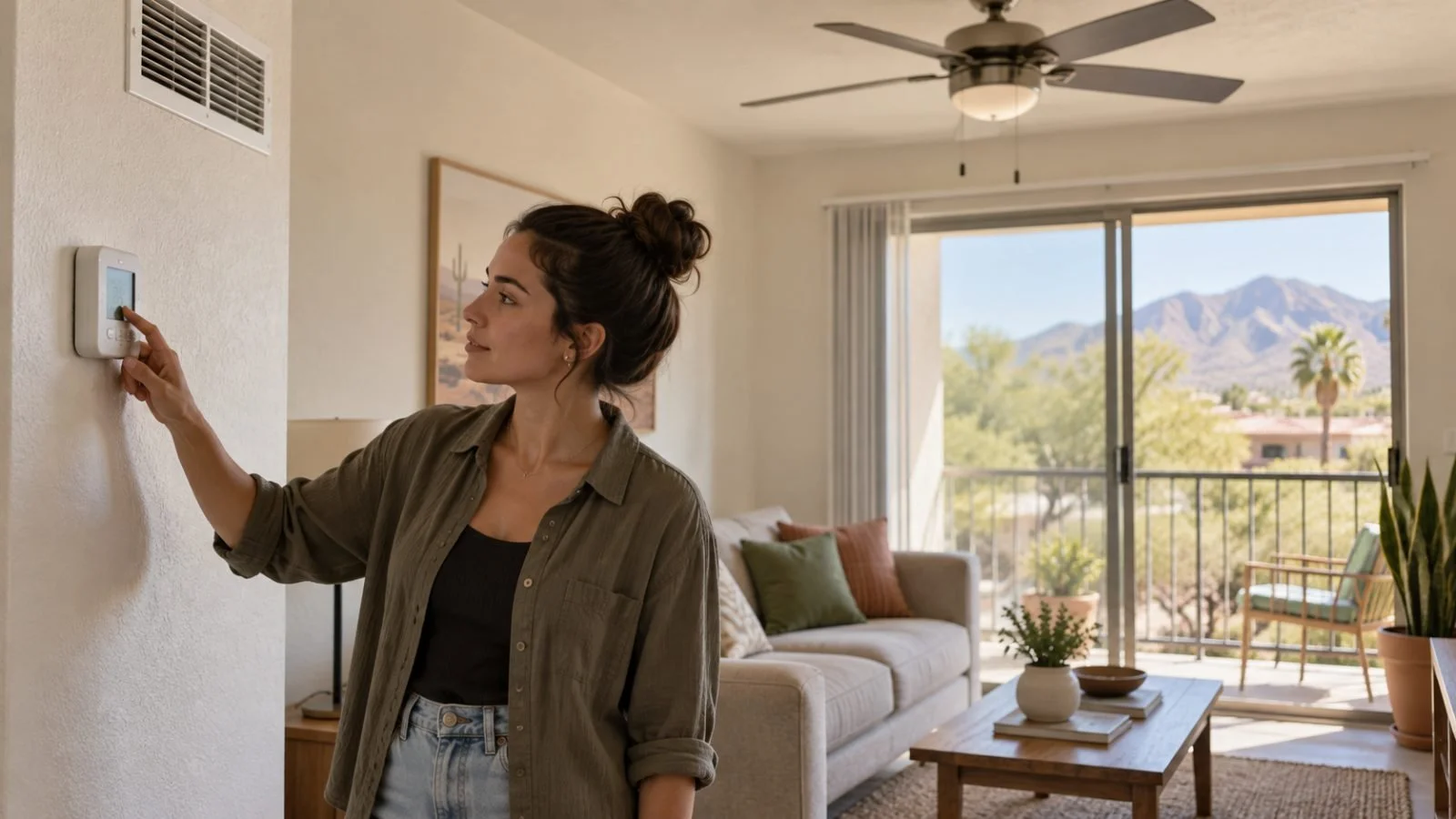
For apartment hunters, the practical lesson starts before move-in. Ask what type of cooling system serves the unit, whether electricity is included, whether the thermostat controls the entire apartment, and how emergency maintenance requests are handled after normal office hours.
Cooling equipment can also affect monthly expenses. Two similarly priced units can have noticeably different total costs depending on efficiency, sun exposure, included utilities, and the type of cooling system. The guide to summer utility costs in Tucson apartments explains why advertised rent alone does not tell you the full monthly cost.
What to do when repairs or essential services become a problem
A broken appliance is not automatically a legal emergency, and Arizona rental law does not use one universal deadline for every possible maintenance problem.
The correct response depends on what failed, how serious the condition is, what the lease requires, and which part of Arizona law applies. An air-conditioning failure during extreme summer heat, for example, deserves different attention from a loose bedroom doorknob.
The safest practical approach is to create a clear written record before deciding what to do next.
Use a written repair process
A useful repair workflow looks like this:
Document the condition. Take clear photos or video and record when you first noticed the problem.
Submit the request in writing. Use the property's maintenance portal, email system, or another documented reporting method.
Describe the actual problem. Include useful details such as temperatures, leaks, error messages, affected rooms, or whether an appliance has completely stopped working.
Keep management's responses. Save appointment dates, contractor visits, emails, text messages, and maintenance-ticket updates.
Provide reasonable access for repairs. Coordinate with management when someone needs to inspect or repair the unit.
Escalate serious unresolved issues appropriately. Health, safety, essential-service, or eviction-related problems may justify contacting a tenant assistance organization or attorney.
Written communication does not need to sound legalistic. In fact, straightforward wording is usually more useful.
Instead of writing, "You are violating my tenant rights," describe what happened: "The AC stopped cooling at approximately 2 p.m. yesterday. The bedroom temperature reached 86°F this afternoon. I submitted maintenance request 1472 yesterday and am requesting an update."
That gives everyone something concrete to work from.
Do not automatically withhold rent
One of the riskiest mistakes a renter can make is independently deciding that an unresolved repair means rent no longer needs to be paid.
Arizona law provides remedies for certain forms of landlord noncompliance, but those remedies have specific conditions. Notice requirements, the type of problem, the seriousness of the condition, and the remedy being used can all matter.
That is why a tenant should not assume that paying a contractor and subtracting the amount from next month's rent is automatically allowed.
Example: A Tucson renter discovers that the central air conditioner has stopped cooling during July. Instead of immediately hiring a contractor and deducting the full invoice from the next rent payment, the renter submits an urgent written maintenance request, records indoor temperatures, keeps the maintenance-ticket number, and makes the unit available for inspection. If management does not resolve the problem, the renter now has a documented timeline that can be used when reviewing the applicable legal remedy or seeking professional guidance.
This approach protects the renter from turning one dispute into two.
Essential services can require faster attention
Water, electricity where the landlord is responsible for supplying it, hot water, heating, and installed cooling can raise more serious concerns than ordinary cosmetic maintenance.
If an essential service fails, document when the failure began and contact management promptly. Describe whether the service is completely unavailable or only partially functioning.
Do not rely solely on a telephone conversation if the problem is serious. Follow up in writing so there is a timestamped record of the report.
If the issue creates a significant health or safety concern or remains unresolved, check the applicable state or local requirements and seek qualified assistance before attempting a legal remedy on your own.
Keep retaliation concerns documented too
Disagreements sometimes become more complicated after a tenant complains about maintenance or housing conditions.
Arizona law addresses certain forms of landlord retaliation when a tenant engages in protected activity. However, not every rent increase, lease nonrenewal, inspection, or disagreement following a complaint automatically qualifies as retaliation.
This is another reason documentation matters. Keep the original complaint, maintenance requests, dates, responses, notices, rent records, and any later communication together. A clear timeline is much more useful than trying to reconstruct events months later.

Lease violations, rent changes, and eviction in Arizona
Eviction is one subject where renters should be especially cautious about relying on social media, old forum posts, or a friend's experience in another state.
Arizona uses specific notices and court procedures. The requirements and timing depend on why the landlord is seeking possession.
A nonpayment case, a material lease violation, and a more serious breach may follow different procedures.
A landlord cannot simply replace the court process
A disagreement does not normally allow a landlord to bypass Arizona's legal process and simply remove a tenant from the property.
Arizona's court system provides official information about notices, eviction filings, hearings, judgments, and possession. Tenants facing a notice or lawsuit should use the Arizona Judicial Branch's landlord and tenant eviction resources rather than relying on generalized advice from another state.
It is also important to distinguish between a notice from a landlord and a court judgment.
Receiving a notice does not mean the court has already ordered an eviction. However, ignoring the notice or later court paperwork can make the situation much harder to address.
Eviction involves a court case
If a dispute is not resolved and the landlord proceeds with an eviction action, the matter enters the court system.
The renter may have an opportunity to respond and appear in the case. Because Arizona eviction matters can proceed quickly, tenants should read every document immediately and pay close attention to dates.
If you believe the landlord's allegations are incorrect, do not assume that means you can ignore the summons. Gather the lease, payment records, maintenance correspondence, notices, photographs, and any other documents connected to the dispute.
Legal aid or an Arizona attorney can help explain how those facts apply to a particular case.
What about rent increases?
Rent changes depend partly on the type of tenancy.
With a fixed-term lease, the agreed rent usually applies for the term stated in the contract unless the agreement and applicable law allow a change. Month-to-month arrangements operate differently and can involve notice requirements tied to the periodic rental date.
Renters deciding whether to renew should also compare more than the new base rent. Utility charges, parking, internet, pet costs, recurring service fees, and other expenses can substantially change the real monthly cost.
The breakdown of average rent and rental costs in Tucson can help put a renewal offer or new listing into a broader local context.
A Tucson renter's checklist before and during a lease
Knowing the law is useful, but most renters benefit even more from a routine that prevents small misunderstandings from becoming larger disputes.
Use this checklist from the first apartment tour through move-out.
| Stage | What to check | Why it matters |
|---|---|---|
| Before applying | Rent, deposits, fees, utilities, pet costs, and parking | The advertised rent may not equal your total monthly or move-in cost |
| Before signing | Lease term, due dates, utility responsibility, maintenance procedures, entry provisions, and renewal terms | Verbal statements may differ from the written agreement |
| Move-in day | Complete the condition form and photograph existing damage | Creates a record of conditions that existed before your tenancy |
| During tenancy | Report repair problems promptly and in writing | Establishes a clear maintenance timeline |
| Tucson summer | Check cooling performance and report failures promptly | Cooling problems can become serious quickly during extreme heat |
| Before moving | Review notice requirements and move-out procedures | Helps prevent avoidable lease and deposit disputes |
| After surrender | Keep your lease, photos, notices, payment records, and forwarding-address information | Provides documentation if a later dispute develops |
Keep one rental file
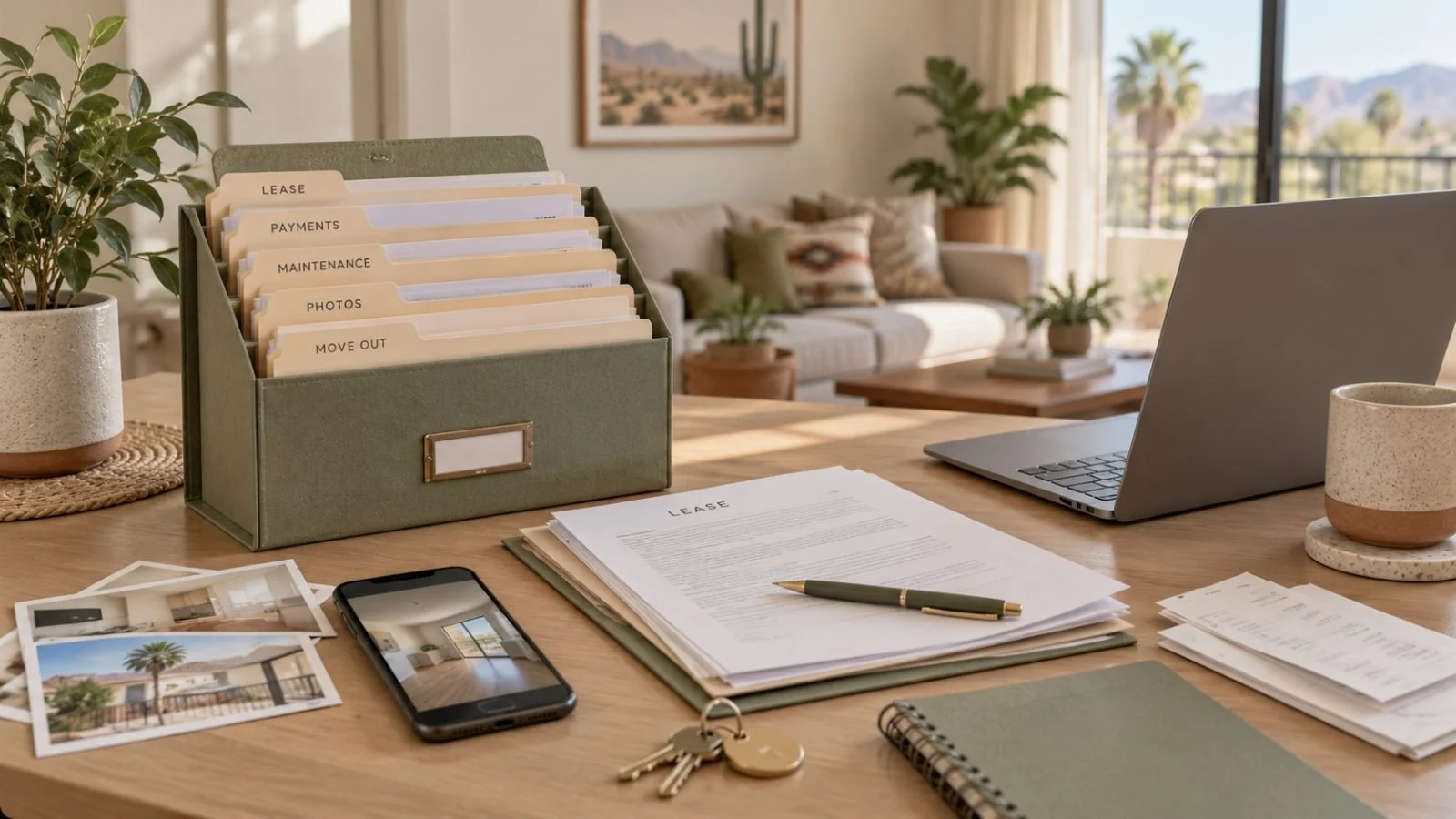
Create one digital folder for your tenancy and keep everything there.
Save the signed lease, addenda, move-in checklist, receipts, maintenance requests, photographs, property notices, inspection messages, and move-out records. Name files with dates so you can quickly reconstruct the timeline later.
This habit is useful even when nothing goes wrong. If you eventually dispute a fee or need to confirm when maintenance was reported, the information is already organized.
Compare the physical property, not just the lease
Tenant protections matter, but the condition and design of the apartment can affect your daily experience long before a legal question arises.
During a tour, look at windows, shade, parking, exterior lighting, laundry access, cooling equipment, water pressure, locks, common areas, and obvious signs of deferred maintenance. Ask which utilities are included and who handles maintenance requests.
Building characteristics can differ even within the same part of Tucson. Renters exploring centrally located properties can compare Midtown Tucson apartments while paying attention to both the written lease and the condition of the specific unit they are considering.
Know when a problem needs outside help
Many routine maintenance issues can be resolved directly with property management. Others warrant outside guidance.
Consider seeking qualified assistance when you receive eviction paperwork, lose an essential service for an extended period, believe the home has a significant safety problem, face a substantial security-deposit dispute, or are unsure whether a legal notice or remedy applies to your situation.
Getting advice early is usually more useful than waiting until a deadline is about to expire.
Know your lease, document problems, and act early
The most useful tenant habit is not memorizing every section of Arizona landlord-tenant law. It is understanding the basic rules, reading your lease carefully, documenting the apartment's condition, and putting important communication in writing.
For Tucson renters, that matters most when an issue involves cooling, essential services, deposits, landlord access, or a threatened eviction. Handle ordinary concerns through the property's normal process, but recognize when the situation has become serious enough to check the applicable law or get qualified legal guidance.
FAQs
How much can a landlord charge for a security deposit in Arizona?
Arizona generally limits security and prepaid rent that a landlord may demand to one and one-half months' rent, although a tenant may voluntarily pay more rent in advance. Review the written lease carefully because refundable deposits and nonrefundable fees are treated differently.
How long does an Arizona landlord have to return a security deposit?
Arizona law establishes a process and deadline for providing the refundable balance and an itemized statement of deductions after the tenancy ends and the required conditions are met. Keep your forwarding address, move-out photographs, lease, and key-return documentation until the deposit has been resolved.
Does a landlord have to give notice before entering an Arizona apartment?
Arizona landlords generally must provide at least two days' notice and enter at reasonable times, although exceptions apply. Emergencies and entry connected with a tenant's maintenance request can be treated differently.
Can I withhold rent if my landlord will not make repairs?
Do not assume that a delayed repair automatically gives you the right to stop paying rent. Arizona provides different remedies for different forms of noncompliance, and some require written notice or other specific steps. Seek qualified legal guidance if you are considering withholding or deducting rent.
What are my tenant rights in Tucson if the air conditioning stops working?
Report the problem immediately in writing and document indoor conditions, including temperatures if possible. Arizona landlord duties and Tucson's local cooling requirements may both be relevant, depending on the unit and circumstances.
Can an Arizona landlord evict me without going to court?
Arizona landlords generally must use the applicable notice and court process to recover possession rather than simply removing a tenant themselves. If you receive a summons or other court paperwork, read it immediately and consider contacting a qualified Arizona legal assistance provider.
What should I do if I receive an eviction notice in Tucson?
Save the notice, identify the stated reason and deadline, and gather your lease, payment records, correspondence, and other supporting documents. If you cannot resolve the issue promptly or dispute the landlord's allegations, seek qualified legal assistance as early as possible.